
U.S. and UK Diverge on AI Copyright as Trump Framework Shields Training Practices
Washington declares AI training on copyrighted works lawful while London retreats from opt-out model, exposing transatlantic regulatory split with global commercial implications.
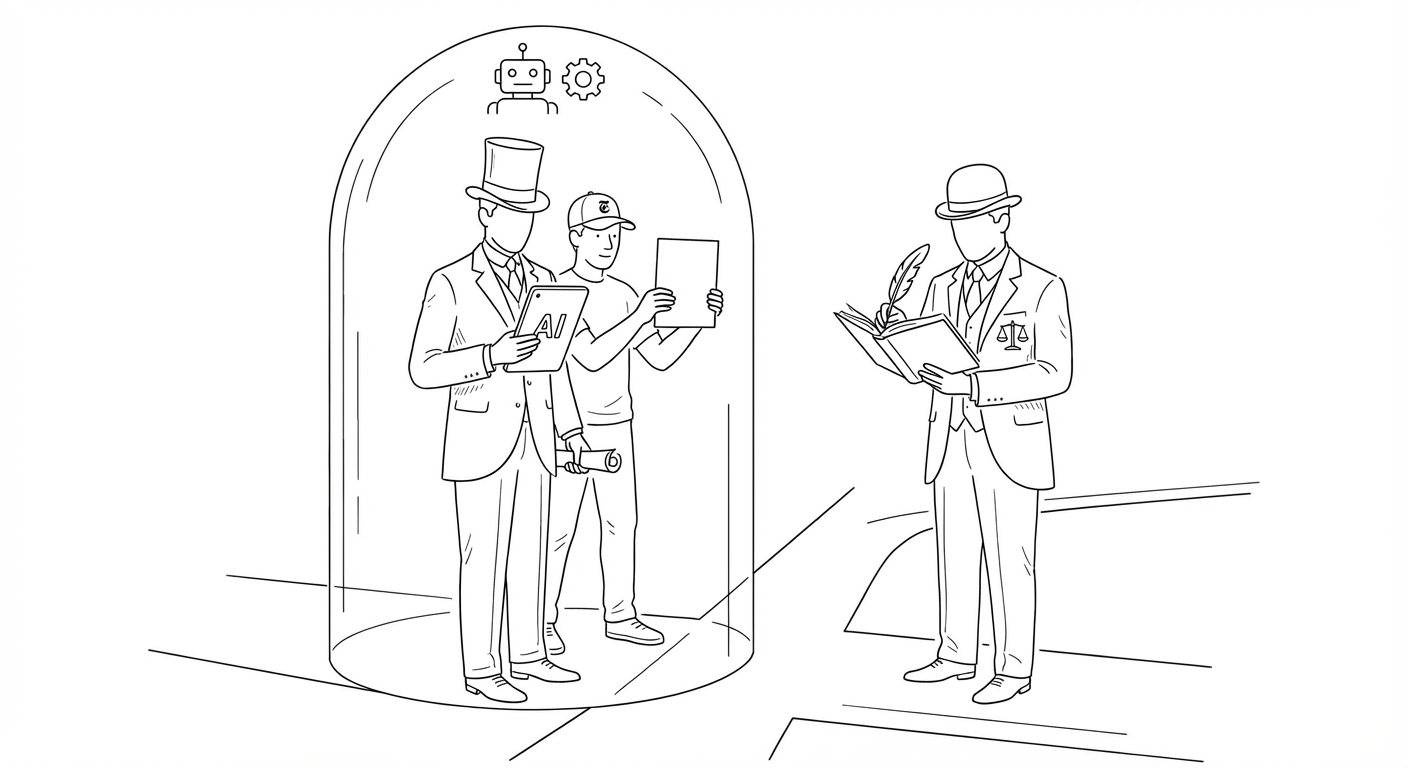
The United States and United Kingdom are charting opposing courses on artificial intelligence copyright policy, with the Trump Administration asserting that training AI systems on copyrighted material does not violate copyright law while Britain has abandoned its preferred regulatory approach after industry resistance.
The divergence marks a critical juncture for global AI governance, as the world's two leading financial centers adopt incompatible frameworks that will shape how technology companies, content creators, and legal systems navigate intellectual property rights in the machine learning era. The U.S. framework explicitly leaves fair use determinations to the courts rather than establishing new statutory restrictions, creating a permissive environment for AI developers in the near term while preserving significant legal uncertainty.
In contrast, the United Kingdom recently retreated from an opt-out model that would have given copyright holders more control over whether their works could be used for AI training. The British government now lacks a settled position following pushback from technology industry stakeholders, leaving companies operating across both jurisdictions without clear guidance on compliance requirements.
(The policy split emerges as broader debates intensify over AI's economic and democratic costs, with polling showing more than 70 percent of U.S. voters favor both state and federal regulation despite the Trump Administration's industry-aligned stance.)
The transatlantic divergence carries immediate commercial consequences for multinational technology firms, media companies, and creative industries that must navigate conflicting legal regimes. U.S.-based AI developers gain regulatory latitude that their UK counterparts may not enjoy, while content owners face fragmented protections depending on jurisdiction. Courts in both nations will ultimately determine the boundaries of permissible AI training practices, but the starting positions now differ fundamentally.
The copyright question intersects with mounting concerns about AI's systemic risks, including concentrated investment in hyperscale infrastructure, supply chain vulnerabilities tied to Middle East energy and semiconductor production, and the technology sector's growing political influence. Analysts have warned that the AI industry's financial structure—including $121 billion in hyperscaler debt issued in 2025—could amplify economic shocks if geopolitical disruptions affect data center construction or energy supplies.
The regulatory divergence also reflects deeper tensions over who bears the costs of AI deployment. Critics argue that companies profiting from AI must internalize harms including job displacement, erosion of journalism and education quality, and concentration of power in monopolistic firms. The Trump Administration's framework has been characterized as industry capture that contradicts voter preferences across both political parties, setting up AI regulation as a contested issue in upcoming congressional elections.
Keywords
Sources
https://www.thefashionlaw.com/ai-copyright-what-companies-in-the-u-s-and-uk-need-to-know/
Frames transatlantic split as emerging policy divergence with direct implications for companies navigating both jurisdictions
https://www.theguardian.com/commentisfree/2026/mar/24/midterm-elections-ai-voters
Emphasizes voter opposition to Trump AI order and argues regulation is now political issue requiring electoral accountability
https://letsdatascience.com/news/ai-industry-risks-trigger-global-economic-shock-2b7cf32b
Highlights systemic economic risks from AI infrastructure debt and supply chain concentration that could amplify shocks
https://www.law360.com/pulse/legal-tech/articles/2458510/legal-tech-roundup-epiq-questel
Covers legal technology sector developments and industry trends relevant to AI implementation in law firms