
OpenAI Pushes Life Sciences AI Expansion as Drug Discovery Track Record Stalls
OpenAI is lobbying for broader AI adoption in biomedical research, citing speed gains, even as no fully AI-discovered drug has cleared Phase 3 trials.
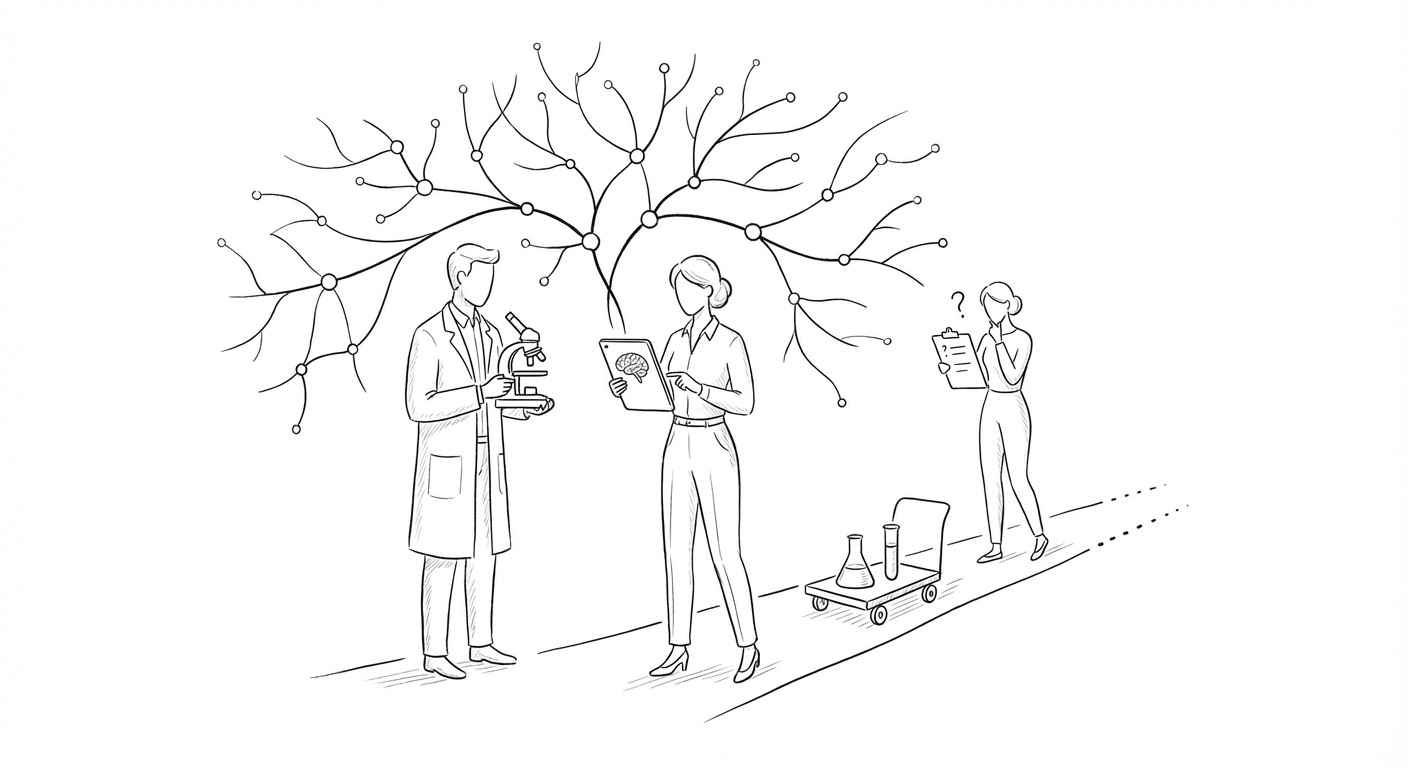
OpenAI is mounting a policy push to expand artificial intelligence's role in life sciences research, arguing that AI can compress drug discovery timelines and automate laboratory work, despite a mixed track record in clinical trials.
The company shared a report with Axios in mid-April claiming that AI tools can cut clinical-phase timelines by more than 20 percent and repurpose FDA-approved drugs for diseases lacking treatments. OpenAI positioned its GPT-5 Pro model as capable of synthesizing evidence and generating hypotheses to accelerate biomedical discovery, which currently takes 12 to 15 years from research to approval in the United States.
Yet no fully AI-discovered or AI-designed drug has completed Phase 3 trials, and AI-discovered candidates have failed Phase 2 trials at rates similar to traditional drugs, according to a mid-2025 Nature Medicine paper. "The question of whether AI can impart meaningful, sustained disruption to drug development has remained unanswered," the researchers wrote.
OpenAI acknowledged that hallucinations, bias, and inaccuracies persist, though less frequently than before. The company said it views AI as a tool to support analysis, not replace expert judgment or real-world validation, and that it "rigorously" measures accuracy across scientific domains.
Meanwhile, AI-related papers in natural science, physical science, and life science rose 26 to 28 percent year-over-year in 2025, according to Stanford's 2026 AI Index Report. The same report noted that AI completed an end-to-end weather forecasting process for the first time this year, producing temperature, wind speed, and humidity forecasts from raw data without traditional numerical models.
(OpenAI's lobbying effort comes as the company seeks new revenue streams beyond consumer chatbots and enterprise software, with life sciences representing a high-value vertical where regulatory approval timelines and research costs create strong incentives for automation.)
The pharmaceutical industry has long struggled with "Eroom's Law"—Moore's Law in reverse—which holds that scientific research slows as knowledge accumulates, because each generation of scientists must spend more time absorbing prior work. OpenAI argues that AI, with unlimited time and processing capacity, can overcome this bottleneck by synthesizing siloed knowledge and designing new tools autonomously.
Elsewhere in the AI sector, cybersecurity firms are deploying AI for threat detection at scale, with Gartner forecasting that 50 percent of threat detection platforms will incorporate agentic AI by 2028, up from less than 10 percent in 2024. A Google study of 3,466 senior leaders found that 85 percent of early AI adopters reported improved threat identification. Factory, an AI coding startup, is in talks to raise $150 million at a $1.5 billion valuation led by Khosla Ventures, with participation from Sequoia Capital, Insight Partners, and Blackstone, as reported by The Wall Street Journal. Investment scams leveraging AI-generated content have also surged, according to multiple consumer protection reports.
Keywords
Sources
https://www.axios.com/2026/04/15/exclusive-openai-ai-life-science
Exclusive report on OpenAI's policy push for life sciences AI adoption despite unproven clinical trial outcomes
https://m.theblockbeats.info/en/news/61982
Stanford AI Index data showing 26-28% rise in AI-related life science papers and first end-to-end AI weather forecast
https://www.csoonline.com/article/4154239/how-ai-is-transforming-threat-detection.html
Gartner forecast on agentic AI adoption in cybersecurity and Google study showing threat detection improvements
https://www.wsj.com/tech/ai/an-investor-dared-him-to-quit-school-now-hes-building-a-1-5-billion-ai-startup-d8663e72
Factory AI coding startup raising $150M at $1.5B valuation with Khosla Ventures leading the round
https://ca.news.yahoo.com/scams-ai-tech-trick-consumer-205211145.html
Consumer Reports coverage of AI-powered investment scams targeting individuals