
Marketers Warned Against 'LLM-Centricity' as AI Reshapes Consumer Touchpoints
Industry voices urge brands to resist ceding control to large language models, citing negativity bias in training data and the risk of abandoning customer-first strategy.
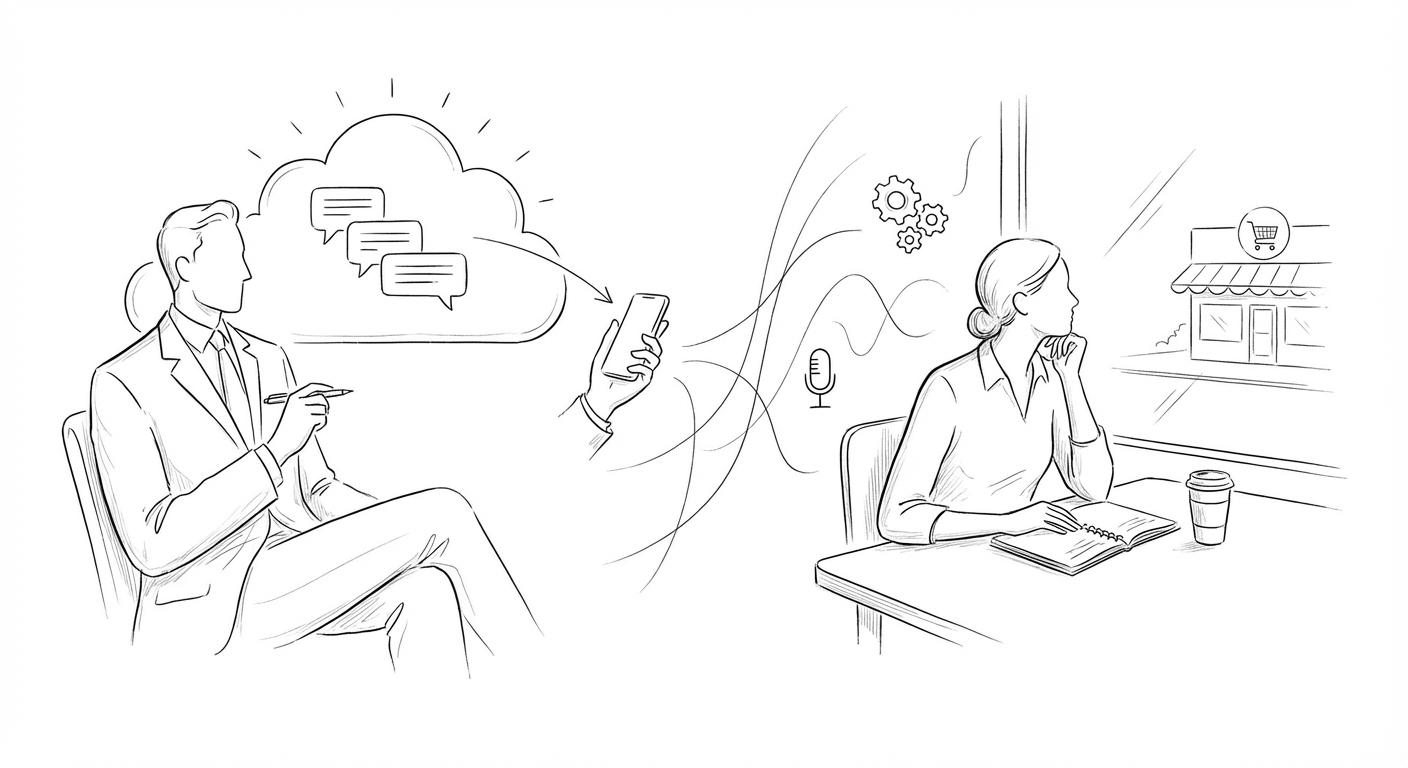
Marketing strategists are cautioning brands against subordinating customer-centric practices to the demands of large language models, as AI-mediated search and recommendation systems become primary consumer touchpoints.
Tony Jarvis of Olympic Media Consultancy warned that LLMs operate in "a sea of negativity" shaped by the disproportionate volume of critical reviews and complaints online. "AI further amplifies negativity," Jarvis wrote, arguing that marketers risk steering consumers toward this "whirlpool of negative reviews" by passively optimizing for AI systems rather than actively guiding customer journeys. He called for industry-wide collaboration to open LLM access to broader, less biased information sources and to educate consumers on effective AI interaction.
The debate arrives as platforms rebuild core algorithms around LLM architectures. LinkedIn announced it is replacing its main feed ranking system with a GPU-powered model using advanced language models to deliver "more complex representations" of users and content, aiming for recommendations that track "evolving interests" in real time. The company framed the shift as expanding creator reach while surfacing fresher posts.
Meanwhile, specialized applications are advancing faster than regulatory frameworks. Stanford's CREATE center, funded by the National Institute of Mental Health, is developing LLM-based tools to support PTSD treatment implementation, even as millions turn to ChatGPT and similar systems for informal psychological advice. Forbes contributor Lance Eliot noted that "today's generic LLMs are not at all akin to the robust capabilities of human therapists," while state laws in Illinois, Utah, and Nevada governing AI mental health guidance face untested legal challenges.
(Anthropic released a March 5 report concluding that current AI systems achieve only a "fraction" of their theoretical capacity, though the company provided no timeline for closing that gap. Separate research published in Nature examined risks including hallucination, inappropriate clinical responses, and what researchers termed "ChatGPT induced psychosis" documented in user forums.)
The tension reflects a broader power shift in digital commerce and information access. For two decades, brands optimized for Google's search algorithms; LLMs now introduce a new intermediary layer with less transparent ranking logic and training data skewed toward user complaints. HAIL AI, a Florida-based startup, announced a "multi-system AI architecture" designed to reduce hallucination in web-published content by orchestrating outputs across multiple models before publication, signaling demand for governance layers atop existing LLM infrastructure.
Law firms and corporate legal departments, facing pressure to adopt AI tools, are prioritizing stakeholder feedback over technology-first implementation, according to a March 11 Law360 panel. At Goodwin Proctor, Chief Talent Officer Heidi Goldstein Shepherd emphasized preserving apprenticeship models while integrating AI to support career flexibility, particularly for women returning from parental leave.
Keywords
Sources
https://www.mediapost.com/publications/article/412922/dont-be-dumb.html?edition=141817
Warns marketers against 'LLM-centricity' and urges industry collaboration to counter negativity bias in AI training data
https://www.mediapost.com/publications/article/413486/linkedin-uses-new-ai-models-to-rebuild-feed-algori.html?edition=141918
Reports LinkedIn's algorithmic overhaul using LLMs and GPUs to track evolving user interests in real time
https://www.forbes.com/sites/lanceeliot/2026/03/10/aiming-to-close-the-gap-between-urgently-needed-rigorous-research-on-ai-and-mental-health-versus-the-spiraling-real-world/
Highlights gap between generic LLM capabilities and specialized mental health applications amid regulatory uncertainty
https://www.nature.com/articles/s44220-026-00595-8
Documents mental health risks including hallucination and inappropriate clinical responses in LLM interactions