
Hotels Pivot AI Spending From Pilot Projects to Productivity and Profit Targets
Major hotel brands are shifting artificial intelligence from experimental deployments to structured programs aimed at measurable cost savings and revenue gains, even as execution challenges persist.
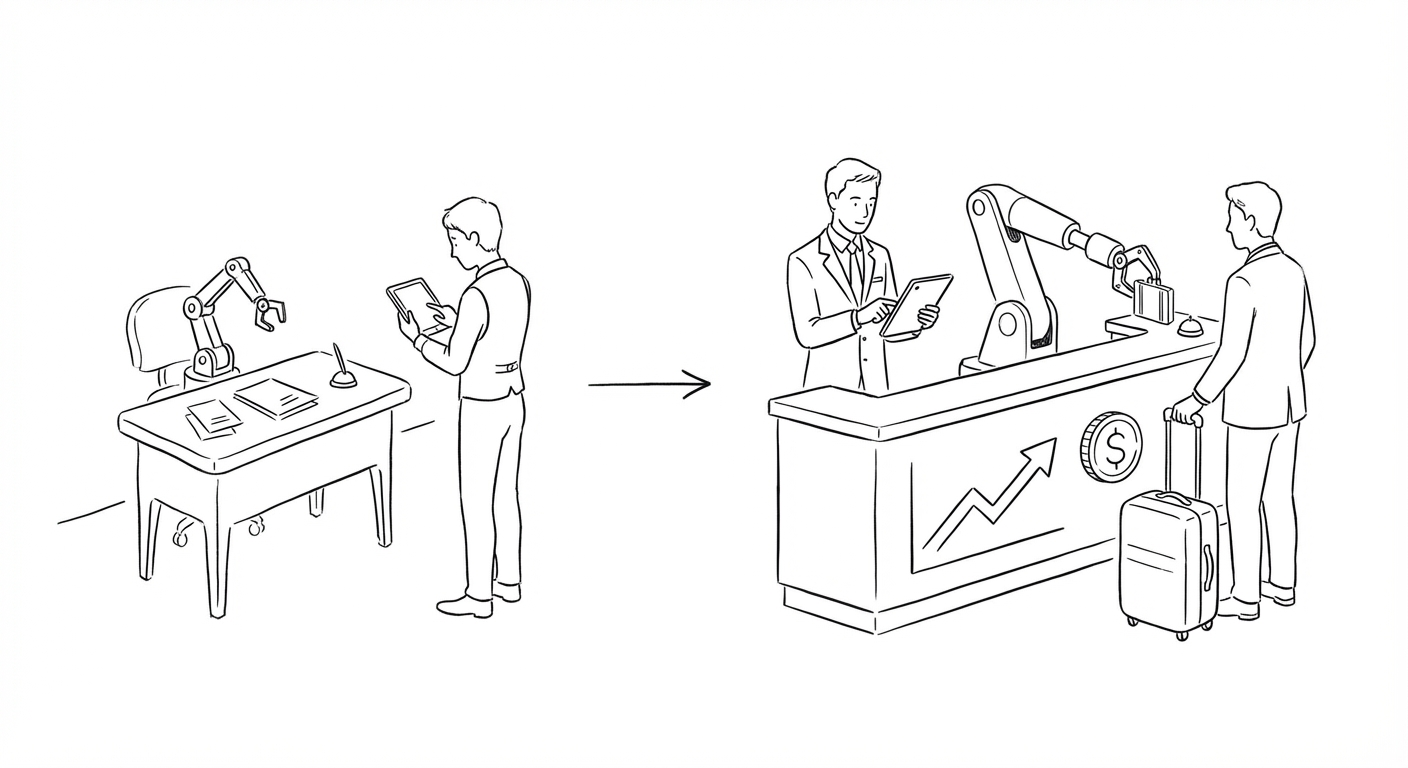
Artificial intelligence is crossing a threshold in the hospitality sector, moving from isolated trials to operational deployments designed to deliver quantifiable financial returns. Major hotel operators are now positioning AI as a tool for productivity gains and cost reduction rather than a speculative technology investment.
The shift reflects a broader recalibration across industries, where early enthusiasm for AI has given way to scrutiny over return on investment. While nearly 90 percent of companies have invested in AI technology, fewer than 40 percent report measurable gains, according to J.P. Morgan Asset Management. The gap between adoption and results has made execution a critical differentiator.
In the hotel sector, the technology is being applied across reservation automation, group sales support, guest messaging, revenue forecasting, and workflow optimization. Hyatt reported that its group sales teams became approximately 20 percent more productive after deploying AI tools, while Wyndham Hotels & Resorts said AI-powered call centers have reduced labor costs for franchisees, according to industry reporting.
The hospitality industry spent roughly two years testing where AI might improve booking systems, customer service, and internal operations. Leading operators are now signaling that the technology is beginning to move into larger, more structured deployments, with a focus on redesigning workflows rather than automating isolated tasks.
(The broader AI investment landscape remains uneven. Recent research found that two-thirds of firms have yet to see return on investment from AI spending, even as three-quarters of UK businesses now use AI tools. Financial services firms, for example, have identified siloed data as the biggest barrier to scaling AI implementation, according to interviews with 400 senior executives across major institutions.)
The hotel sector's pivot mirrors a pattern emerging across industries: companies that initially treated AI as a novelty are now evaluating it as an operational lever, with success increasingly tied to how well organizations integrate the technology into existing processes rather than layering it onto legacy systems. The monetization cycle remains early, and the gap between investment and measurable outcomes continues to define the competitive landscape.
Keywords
Sources
https://www.hotelnewsresource.com/article140546.html
Focuses on hotel sector's shift from experimental AI to structured deployments with specific productivity and cost-saving examples.
https://www.consultancy.uk/news/43541/why-traditional-due-diligence-models-are-struggling-to-keep-up-with-scale
Highlights broader AI ROI challenges, noting two-thirds of firms have yet to see returns despite widespread adoption.
https://www.washingtonpost.com/wp-intelligence/ai-tech-brief/2026/03/20/ai-tech-brief-strategy-behind-gops-ai-framework/
Provides policy context around federal AI framework discussions as private sector grapples with implementation challenges.