
Business Travel Sector Bets on AI to Reverse Post-Pandemic Stagnation
Corporate travel managers are embracing artificial intelligence to automate booking and support, with 72% ready to trust AI with reservations—but generational divides and implementation gaps persist.
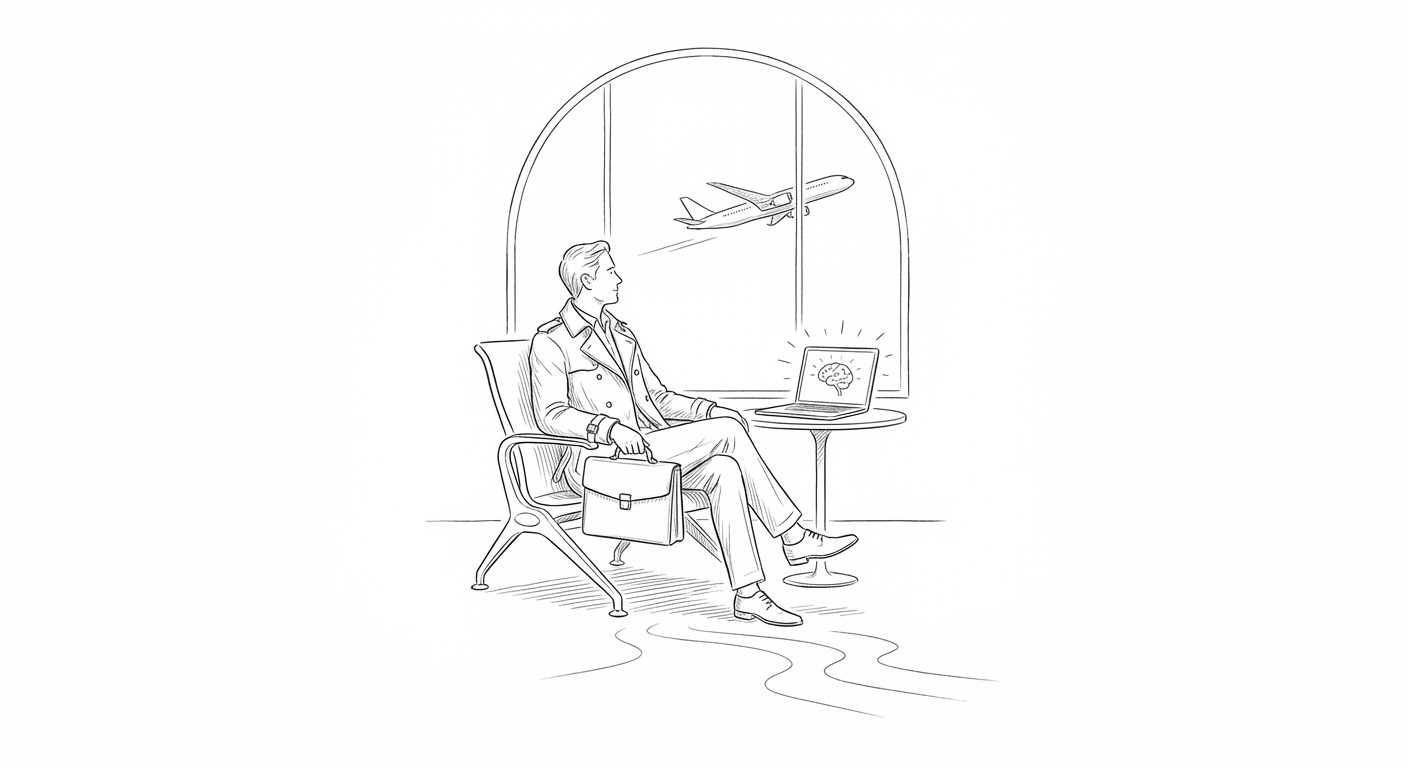
Artificial intelligence is emerging as the primary catalyst behind renewed optimism in business travel, a sector still recovering from pandemic-era disruption and facing persistent doubts about its future trajectory.
New data from American Express Global Business Travel, gathered in February 2026, reveals that 44 percent of business travelers in the United Kingdom and United States now expect smoother work-related journeys within five years—more than double the 17 percent who remain uncertain. The shift is driven largely by expectations that AI will automate time-consuming tasks including itinerary planning, booking coordination, and real-time problem resolution during trips.
Acceptance of automated systems has already reached significant scale. Seventy-two percent of business travelers surveyed said they trust AI to manage reservations without human oversight, while roughly seven in ten believe the technology can effectively respond to issues encountered on the road. The confidence holds even under operational pressure, suggesting a fundamental recalibration of expectations around machine-assisted travel management.
Younger professionals are leading the adoption curve. Workers under thirty—broadly categorized as Generation Z—demonstrate both stronger belief in AI's capacity to improve business travel and greater overall optimism about the experience itself. This dual outlook, combining faith in automated systems with a more positive view of corporate mobility, marks a departure from older cohorts who remain more cautious about delegating travel decisions to algorithms.
The enthusiasm contrasts sharply with broader corporate AI implementation struggles documented across other sectors. Recent industry analysis points to widespread "AI-fatigue" and warns that most communication-focused AI transformations remain trapped in experimental phases, unable to move from pilot programs to operational deployment. Technology consultancies have urged businesses to distinguish between being "AI-ready" and merely "AI-curious" before committing resources to adoption.
(The American Express Global Business Travel findings were published in early March 2026, drawing on survey data collected the previous month from business travelers in two major English-speaking markets.)
The business travel sector has faced sustained pressure since 2020, with corporate travel budgets slashed and remote work policies reducing demand for in-person meetings. Industry observers have questioned whether business travel would ever return to pre-pandemic volumes, making the AI-driven optimism a notable reversal. Alternative legal service providers and consultancies have similarly turned to AI to reshape client relationships, with some law firms now offering subscription-based AI advisory services as alternatives to traditional hourly billing—a parallel shift in how professional services are packaged and delivered.
Whether AI can deliver on the operational promises remains an open question. The gap between experimental deployments and proven return on investment continues to challenge executives across industries, and the business travel sector's bet on automation arrives amid warnings that hasty implementation strategies often prove false economies.
Keywords
Sources
https://www.tourism-review.com/business-travel-uses-artificial-intelligence-more-than-ever-news15363
Focuses on survey data showing 44% optimism and 72% trust in AI for reservations, with emphasis on Gen Z leading adoption.
https://www.consultancy.uk/news/43460/fast-and-cheap-strategies-are-a-false-economy-warns-uk-consultancy
Highlights warnings about AI-fatigue and most AI transformations remaining trapped in experimental phases across sectors.
https://www.law.com/legaltechnews/2026/03/10/falling-billables-and-the-rise-of-alsps-the-impact-of-ai-on-law-firms-and-in-house-teams-/
Reports on AI driving efficiency gains in legal work with uncertain implications for client relationships and billing models.
https://www.law.com/legaltechnews/2026/03/09/debevoise-partners-with-legora-on-2nd-iteration-of-subscription-based-ai-advisory-offering/
Details subscription-based AI advisory services as alternative to hourly billing, paralleling business model shifts in travel.