
AI Productivity Gains Meet Reality as Firms Brace for Rehiring Wave
Half of companies that cut customer service staff citing AI are expected to rehire by 2027, as limitations emerge alongside breakthrough optimization tools.
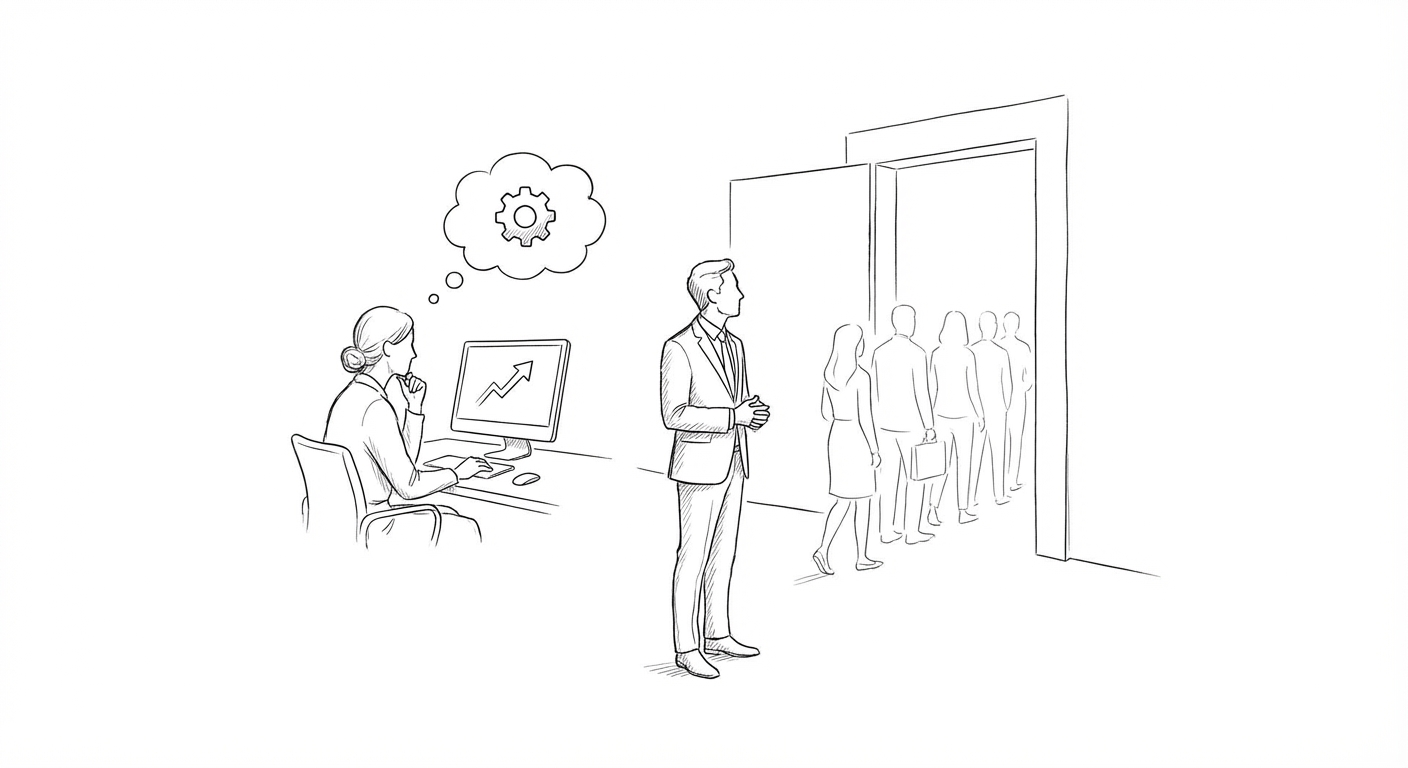
Artificial intelligence is delivering dramatic productivity gains in specialized domains while simultaneously forcing companies to reckon with its limitations in customer-facing roles, creating a bifurcated landscape where technical breakthroughs coexist with operational setbacks.
Research firm Gartner projects that 50 percent of companies that reduced customer service headcount citing AI as the reason will rehire employees for similar roles by 2027. The reversal stems from growing recognition of AI's constraints in handling complex customer interactions. A 2025 Gartner survey of 321 customer service leaders found only 20 percent reported cutting staff explicitly because of AI, suggesting many firms may have overestimated the technology's readiness.
The pattern points toward hybrid models where automation manages routine tasks while humans address high-value interactions. This recalibration comes as other sectors report transformative results from AI deployment.
MIT engineers developed an optimization method described as functioning like a "ChatGPT for spreadsheets," designed to handle tabular data common in engineering design problems. The system identifies critical design variables and concentrates search efforts accordingly. Testing across 60 sample problems showed the model consistently found optimal solutions 10 to 100 times faster than competing algorithms, with applications spanning power grid optimization to vehicle design.
In financial services, generative AI is reshaping software development through what industry observers call "intuitive coding," where developers describe desired outcomes and AI generates corresponding code, documentation, or solutions. Yet many organizations retain generated output while discarding the specifications that created it, missing an opportunity to institutionalize how intent is expressed and validated across development lifecycles.
The technology's dual nature extends to security domains, where AI enables both attack and defense at machine speed. Defenders can now use natural language to generate complex detection rules instantly, while attackers deploy AI to create hyper-personalized phishing campaigns and polymorphic malware that rewrites its own code to evade signature detection.
(The divergent outcomes reflect AI's maturity varying sharply by application domain, with structured technical problems yielding measurable gains while unstructured human interactions expose current model limitations.)
Regulatory frameworks remain fragmented as adoption accelerates. In the United States, hundreds of scientists and former officials signed a "Declaration of Humanity" demanding human interests be prioritized in AI development, offering what proponents describe as a safe roadmap at a time when government has not established clear rules. Legal regulations top executive concerns about further implementation, particularly in Europe, while practitioners cite cost and privacy issues as primary barriers.
Social media platform X is investigating racist and offensive posts generated by xAI's Grok chatbot, according to Sky News, underscoring governance challenges as AI systems gain broader deployment. The incident reflects ongoing tensions between rapid commercialization and adequate safety testing.
The technology's trajectory suggests a period of consolidation ahead. Experts predict that by 2026, focus will shift from trial phases toward creating formal systems to manage AI tools at scale, as organizations move beyond simple tool usage toward integrating AI as a core component of operations.
Keywords
Sources
https://www.forbes.com/sites/quickerbettertech/2026/03/07/small-business-technology-news-intuit-launches-ai-powered-erp-solution-tailored-for-construction-industry/
Highlights Gartner data on AI-driven customer service cuts and MIT breakthrough in optimization algorithms
https://www.consultancy-me.com/news/amp/12884/software-development-in-financial-services-enters-new-era-as-gen-ai-supercharges-productivity
Examines intuitive coding transformation in financial services and shift toward systematizing AI-generated specifications
https://www.csoonline.com/article/4143077/did-cybersecurity-recently-have-its-gatling-gun-moment.html
Analyzes AI's dual role in cybersecurity, enabling both machine-speed attacks and natural language defense tools
https://zamin.uz/en/technology/193736-new-rules-developed-for-ai-development.html
Reports on Declaration of Humanity initiative and regulatory gaps threatening national security