
AI Becomes Litmus Test for Small Business Lending as Lenders Demand Tech Roadmaps
U.S. lenders now scrutinize borrowers' AI strategies alongside financials, reshaping credit decisions for firms that employ nearly half the private workforce.
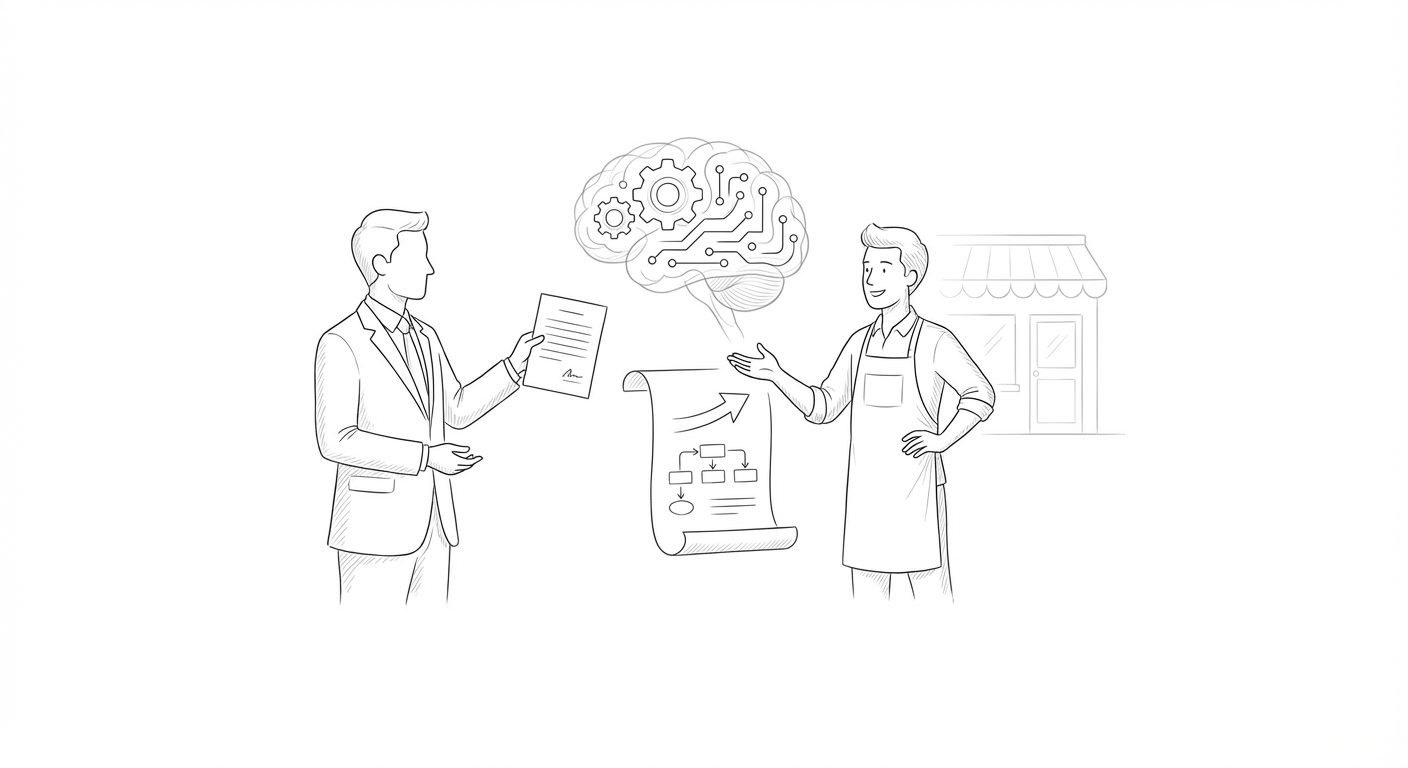
Small business lenders across the United States are increasingly requiring borrowers to articulate how they plan to deploy artificial intelligence, transforming loan underwriting from a purely financial exercise into a strategic technology assessment. The shift comes as firms with fewer than 500 employees—representing 44 percent of U.S. GDP and 46 percent of the private workforce—face mounting pressure to demonstrate they can compete in an economy where software is rapidly replacing human labor.
Chris Hurn, founder and CEO of Lendesca, a fintech building AI-driven software for SBA loan processing, says credit memos that once required a week can now be drafted "in two hours or less" using large language models. As mechanical underwriting tasks become automated, lenders are devoting more attention to what Hurn describes as "the art of judging whether a business will still work in the future." He adds that "the more clerical the task, the more it has a bullseye on it."
The lending criteria reflect broader optimism among smaller enterprises about AI's equalizing potential. A survey of over 300 business leaders from the UK, Netherlands, and U.S. by Eden McCallum found that 32 percent already see significant operational impact from generative AI, with 79 percent expecting major effects within one to three years. Smaller firms view the technology as a way to match the efficiency of larger rivals, with unstructured AI adoption estimated to have boosted labor productivity by 1.3 percent since the public release of consumer platforms like ChatGPT.
Yet the transition is not without friction. Atlassian announced plans to cut roughly 1,600 employees—10 percent of its workforce—in a pivot toward AI and enterprise sales, naming new CTOs to oversee an AI-focused roadmap. The restructuring, expected to conclude by the end of the fourth quarter, reflects investor scrutiny of software firms amid fears that AI could disrupt traditional business models. Top executives at the World Economic Forum's January meeting suggested AI would serve as cover for layoffs already in the pipeline.
(Professional services and real estate firms, along with business support services, account for one-third of small employer firms, according to the Federal Reserve's Small Business Credit Survey—sectors where AI's applicability to writing, research, and analysis is most pronounced, per a 2025 Microsoft research paper analyzing hundreds of thousands of AI interactions.)
Lenders report they have not yet seen loan failures directly attributable to AI displacement, but acknowledge the impact is surfacing in deal selection and due diligence rather than defaults. Clean financials, cash flow, and collateral remain foundational, but understanding a borrower's operational strategy in a world of advancing automation has become equally critical. The dynamic underscores a broader recalibration: as AI tools proliferate—from 14.ai's $3 million-funded customer service agency that can clear ticket backlogs within a day, to Siteimprove's agentic content intelligence platform—the competitive advantage shifts to firms that can articulate not just adoption plans but sustainable differentiation in an increasingly automated landscape.
Keywords
Sources
https://www.forbes.com/sites/brandonkochkodin/2026/03/06/no-ai-plan-no-loan-small-business-lenders-force-main-street-to-face-the-future/
Lenders now require AI roadmaps alongside financials; underwriting automation frees time for strategic business viability assessment
https://www.consultancy.eu/news/amp/13316/ai-is-levelling-the-playing-field-between-small-and-large-companies
Survey shows 79% of leaders expect major AI impact within three years; smaller firms see technology as competitive equalizer
https://www.forbes.com/sites/quickerbettertech/2026/03/07/small-business-technology-news-intuit-launches-ai-powered-erp-solution-tailored-for-construction-industry/
14.ai raises $3M for AI customer service agency; Siteimprove adds agentic tools for accessibility and content intelligence
https://www.itnews.com.au/news/atlassian-to-cut-roughly-1600-jobs-624222
Atlassian cuts 10% of workforce in AI pivot; investors scrutinize software firms amid fears of business model disruption