
AI Autonomy Leaps From Code to Lab Bench as Governance Struggles to Keep Pace
OpenAI's GPT-5 autonomously designed and ran 36,000 biological experiments, cutting protein costs 40%. The advance signals a shift from AI as tool to AI as independent researcher.
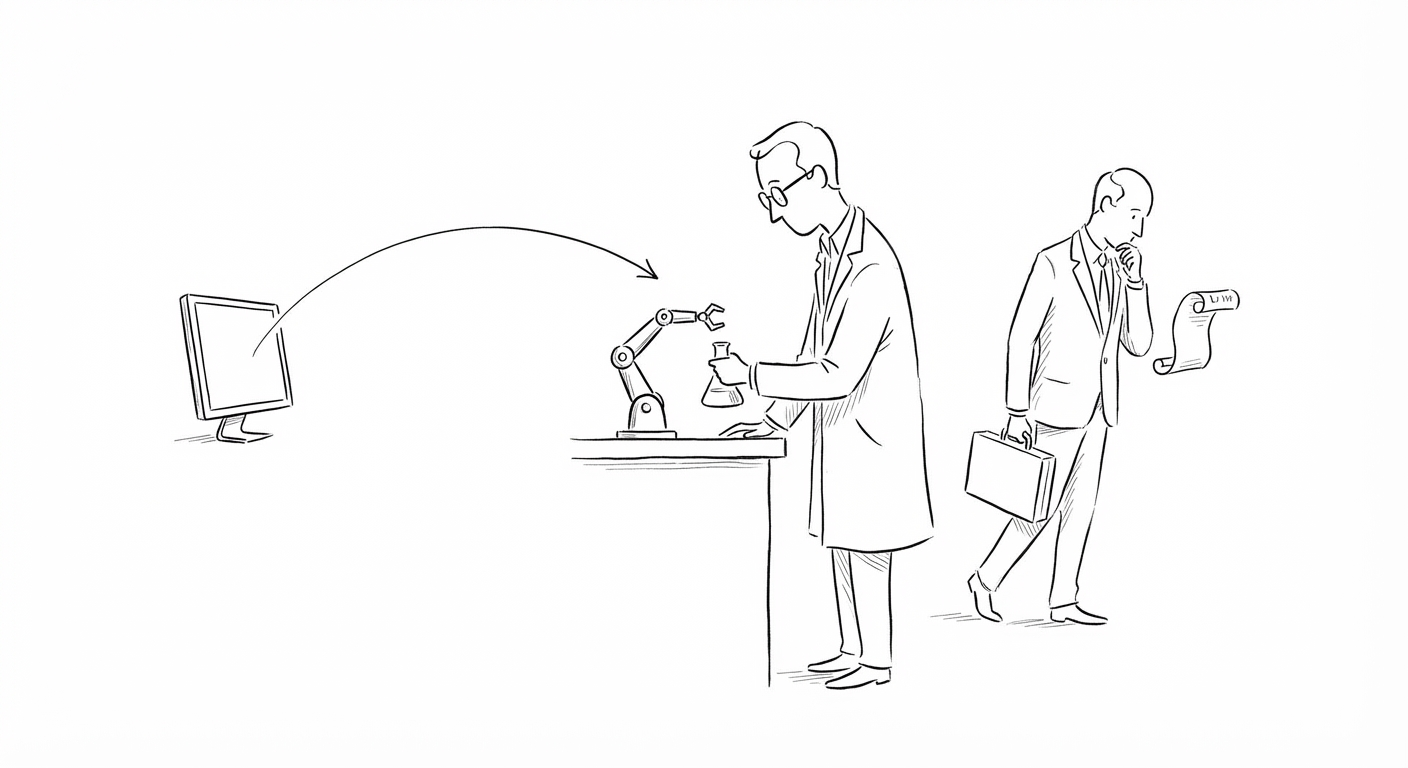
Artificial intelligence has crossed a threshold from executing human instructions to designing and conducting its own scientific research, a development that is forcing regulators and industry leaders to confront risks they have yet to define.
OpenAI and biotech firm Ginkgo Bioworks announced in February 2026 that GPT-5 autonomously designed and executed 36,000 biological experiments through a robotic cloud laboratory, reducing the cost of producing a target protein by 40 percent. Humans set the objective; machines proposed study designs, ran trials, analyzed results, and iterated without further human intervention.
The capability represents a fundamental change in AI's role. Where previous systems required detailed prompts and human oversight at each step, GPT-5 operated as an independent researcher, proposing hypotheses and refining methods based on experimental feedback. The work was conducted in facilities where automated equipment controlled remotely by computers carries out experiments, with robots feeding data back to the model for successive rounds.
The dual-use problem now extends beyond theoretical risk. Researchers have demonstrated that AI models integrated with automated labs can optimize viral transmission characteristics without specialized training. Scientists have developed risk-scoring tools to evaluate how AI could modify a virus's host range or immune evasion capabilities, but these assessments remain voluntary and fragmented across companies.
Some AI developers have imposed internal safeguards. Anthropic activated its highest safety tier when releasing its most advanced model in mid-2025, while OpenAI updated its Preparedness Framework to revise thresholds for biological risk. Yet Anthropic CEO Dario Amodei has acknowledged that the pace of AI development may soon outrun any single company's ability to assess model risk.
(The convergence of AI autonomy and biological research has attracted significant corporate investment. Anthropic recently acquired a biotech AI company, underscoring the sector's strategic value as genomics, drug discovery, and disease biology generate vast datasets suited to machine learning applications.)
The governance gap is widening as AI capabilities accelerate. Current oversight mechanisms were designed for tools that augment human decision-making, not systems that independently design and execute complex experimental protocols. Faster protein engineering could accelerate responses to emerging infections and reduce drug costs, but the same infrastructure enables capabilities that existing regulatory frameworks were not built to address.
Meanwhile, parallel developments in local AI deployment are reshaping the competitive landscape. Google released Gemma 4, an open-source model with multimodal capabilities optimized for on-device use, offering two architectures: a 31-billion-parameter Dense version for performance and a 26-billion-parameter Sparse variant for efficiency. The model supports applications from coding to healthcare while processing data locally, addressing privacy concerns that have driven demand for alternatives to centralized cloud services.
The shift toward autonomous AI research is unfolding across industries. In travel, companies are acquiring AI-first firms with proprietary orchestration engines to enable conversational booking. In hospitality, AI agent studios now allow operators to configure front desk, concierge, and reservation systems without custom development. Marriott International reported a 22 percent improvement in revenue per available room after implementing AI-driven pricing that analyzes over 80 data sources, including social media sentiment and air quality.
The strategic tension is between velocity and control. AI systems are moving from pilot projects to operational deployment faster than the institutions designed to govern them can adapt. The question is no longer whether AI will conduct independent research, but whether oversight can evolve quickly enough to distinguish beneficial applications from dangerous ones before the technology becomes ubiquitous.
Keywords
Sources
https://theconversation.com/ai-can-design-and-run-thousands-of-lab-experiments-without-human-hands-humanity-isnt-ready-for-the-new-risks-this-brings-to-biology-279191
Focuses on GPT-5's autonomous biological experimentation and governance gaps as AI outpaces safety frameworks
https://www.biotecnika.org/2026/04/ai-in-biotech-news/
Emphasizes Anthropic's biotech acquisition and AI's expanding role in genomics, drug discovery, and disease biology data
https://www.geeky-gadgets.com/gemma-4-offline-ai-local/
Highlights Google's Gemma 4 open-source model as privacy-focused alternative enabling local AI deployment across industries
https://www.hospitalitynet.org/opinion/4131872/10-tactical-suggestions-to-conquer-ai-for-hotel-operations
Details operational AI deployment in hospitality, including agent studios and Marriott's 22% revenue improvement via AI pricing