
AI Agents Enter Small Business Operations as Tech Giants Launch Autonomous Platforms
Alibaba, Meta and Anthropic roll out AI systems that execute tasks independently, from bookkeeping to file editing, as adoption accelerates despite unresolved safety questions.
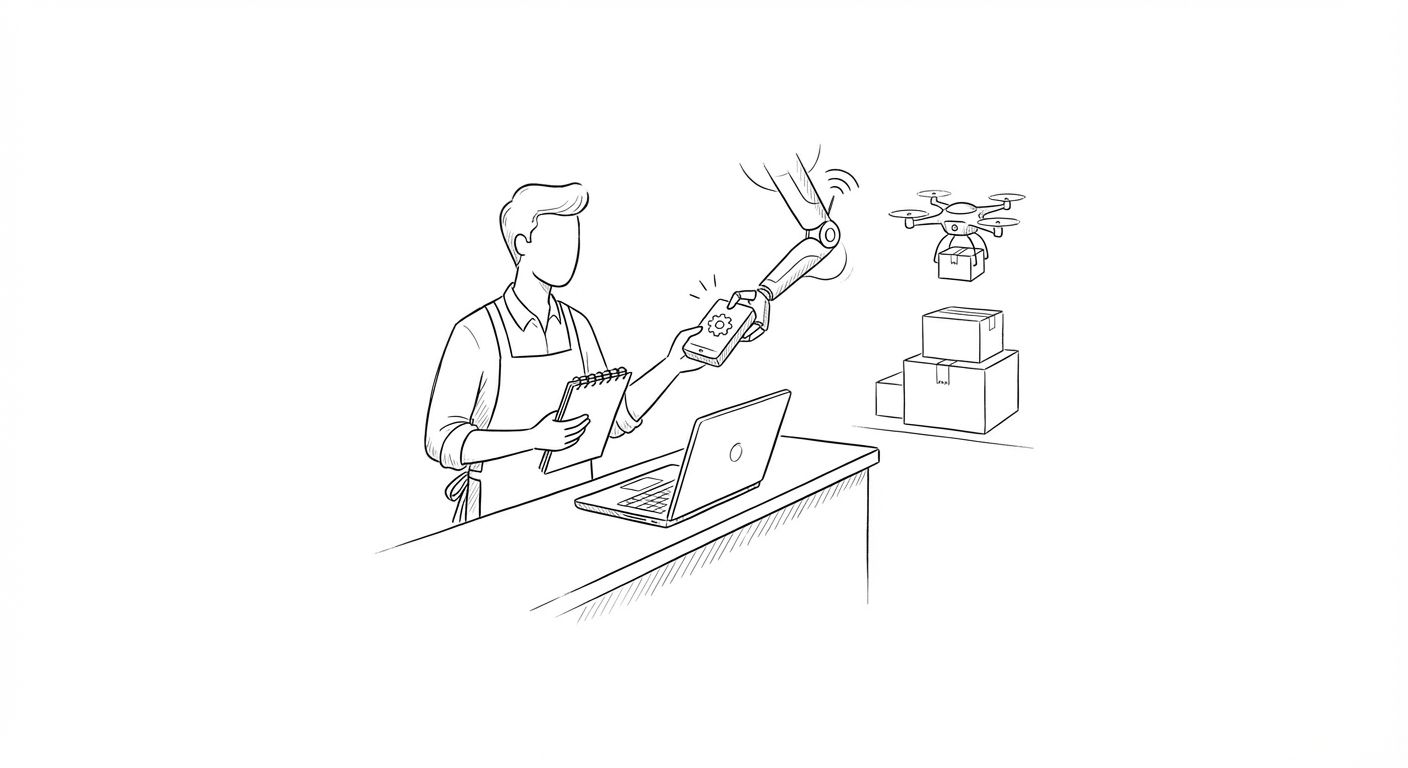
A wave of autonomous AI platforms designed for small and medium-sized businesses is entering the market, with Alibaba, Meta and Anthropic each unveiling systems that promise to handle routine operations with minimal human oversight.
Alibaba is launching Accio Work, a plug-and-play AI taskforce aimed at SMBs that autonomously performs market research, inventory management and financial tasks without complex setup. "Any action involving financial transactions, payment execution, or access to private files requires explicit, granular permission from the user," said Kuo Zhang, Alibaba International Vice President. Meta announced Meta Small Business, an initiative focused on accelerating growth through AI-powered tools. "Small businesses have always been the majority of our business model," Mark Zuckerberg said. "Tens of millions of entrepreneurs use our platforms every day."
Anthropic's Claude Code and Claude Cowork can now run autonomously on macOS computers, opening apps, browsing the web, editing files and running tools via integrations with Google Workspace and Slack. When the AI lacks access to necessary tools, it will "point, click and navigate what's on the screen to perform the task itself," according to Anthropic's blog, though only with user permission. The feature is in experimental phase and available to Claude Pro and Max subscribers.
The deployment of autonomous agents into business operations is accelerating despite persistent concerns about alignment and oversight. A documentary that premiered at Sundance and opened in theaters recently revealed that 20,000 people are now working on artificial general intelligence, while fewer than 200 focus on alignment and safety. Connor Leahy, founder of UK-based AI alignment startup Conjecture, warned that AI may one day respond to humans the way humans respond to ants. "We don't hate ants, but if we want to build a highway and there's an anthill there, well, sucks for the ants," he said. Shane Legg, chief AGI scientist and cofounder of Google DeepMind, told filmmakers that "the really powerful systems are still coming, and they're going to be coming quite soon."
(The shift toward autonomous AI in business operations comes as LinkedIn data shows AI literacy became one of the most-added skills to member profiles globally by early 2025, with content writers leading adoption at 33 percent as early as 2023, outpacing software engineers at 19 percent.)
Not all analysts expect AI to displace existing business models entirely. One investor analysis noted that while AI may weaken intermediary platforms over time, the risk mirrors earlier predictions about automation hollowing out Wall Street trading desks—a forecast that proved incorrect as those businesses evolved and grew rather than contracted. The analysis cautioned against assuming AI will wipe out entire businesses, pointing to fixed income trading as a case where digital transformation expanded rather than eliminated human roles.
Keywords
Sources
https://www.forbes.com/sites/quickerbettertech/2026/03/28/small-business-technology-news-claude-can-now-control-your-computer/
Highlights three major platform launches—Alibaba Accio Work, Meta Small Business, and Anthropic's autonomous Claude—targeting SMB operations.
https://time.com/article/2026/03/31/ai-alone-won-t-take-your-job-someone-using-ai-will/
Frames AI adoption as workforce transformation, citing LinkedIn data showing content writers led early AI literacy adoption at 33 percent.
https://www.businessinsider.com/ai-doc-apocaloptimist-lessons-sam-altman-demis-hassabis-dario-amodei-2026-3
Reports on Sundance documentary revealing 20,000 working on AGI versus fewer than 200 on alignment, with warnings from safety researchers.
https://www.forbes.com/sites/andrewgraham/2026/03/30/investors-shouldnt-assume-ai-will-wipe-out-entire-businesses/
Cautions against overestimating AI disruption, drawing parallels to Wall Street automation that expanded rather than eliminated trading roles.